
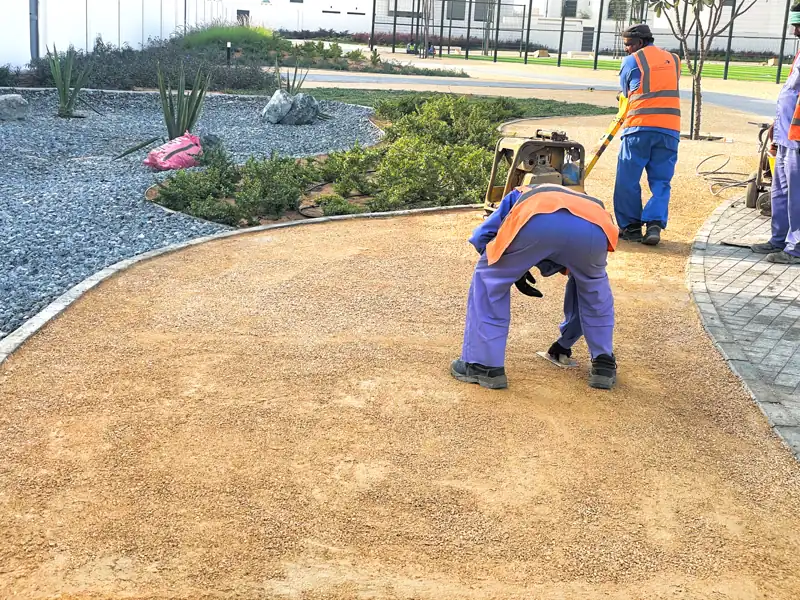
Soil and sand stabilizer is becoming increasingly prevalent in outdoor landscape designs. It preserves a natural soil texture that blends seamlessly into the environment, eliminating the visual discomfort of artificial materials while reinforcing the surface and suppressing dust and dirt. Environmentally friendly, water-based acrylic formulas like our TerraTight™ Stabilizer keep landscapes odourless, non-toxic, and safe for people, plants, and pets.
Many contractors have enthusiastically embraced the product but have faced issues during construction. Even when they follow the construction steps and recommended usage, they sometimes fail to bind the particles and form the intended surface. In such cases, they naturally suspect the chemical is defective. As both the developer and manufacturer of soil and sand stabilizers and an experienced contractor, we have helped numerous clients resolve these issues. In most cases, our analysis shows the chemical is not at fault — the real cause lies in overlooked procedural details. Below are several key tips to improve your construction outcomes.
1. Watch Out for Pot Life
The Problem: Inexperienced workers often extend the application process beyond the pot life of the chemical. After the adhesive has passed its peak bonding time, they continue compacting or levelling, which breaks the bond and wastes the chemical.
Why It Happens: Unlike polyurethane, acrylic does not dramatically solidify when it reaches the end of its pot life, so people tend to forget that — like all adhesives — it loses bonding ability over time. Take our TerraTight™ Stabilizer as an example: its bonding strength typically peaks within 30–40 minutes after use. Any agitation in the form of pouring, stirring, or spraying accelerates the chemical reaction.
The Solution: Always pay close attention to the pot life indicated on the container and strictly time your operations. We recommend planning construction in zones — for example, 20 m² for each half-hour session. Use a simple log chart to track start time, first spray, compaction, and end time per zone, and assign a worker to keep it updated.
Aim to complete all pressure-applying activities (compacting, levelling, sanding, etc.) within the pot life. Topcoat spraying or decorative work can be done later, once the previous layer has fully cured. Also note: it is normal for the tack to feel relatively low immediately after opening the lid, because the reaction is only just starting. Do not wait for the fluid to feel sticky before beginning construction.
2. Scratch and Shuffle to Avoid Surface-Only Binding
The Problem: Some contractors only spray the chemical heavily onto the surface, creating a thin bonded shell that easily cracks under pressure. To increase strength, they apply multiple coats — but the chemical still does not penetrate deeply enough to form a thick, durable structure.
Why It Happens: Many online videos show acrylic stabilizers as a simple spray-and-go solution. For small-scale, non-load-bearing applications — such as binding a few loose rocks for decoration — simple spraying is often sufficient. Load-bearing surfaces require more sophisticated construction. This is why we always distinguish between "soil and sand stabilizer" and a general "rock and mulch adhesive".
The Solution: The strength of the surface comes from depth, so we must help the chemical penetrate below the surface. After the first spray, use a shovel, rake, or similar tool to scratch the surface and shuffle the particles — bringing uncovered particles to the top and spraying chemical onto them. Continue this process until most particles down to a reasonable depth (3–5 cm) are thoroughly coated before moving on to compaction.
During construction, the team must carefully ensure all areas look "wet" throughout application, as compaction and levelling can expose dry particles. In our projects, we assign one person specifically to spraying, continuously applying more chemical to any dry areas.
Although it may be tempting to construct soil and sand stabilizer surfaces using a resin-bound-style mixing and paving method, our experience shows this often leads to excessive usage. Acrylic, especially when diluted with water, is very fluid — when mixed with particles in a bucket and then paved, much of it sinks into the substrate. As a general principle, invest more resin in the initial application rather than in the topcoat.
3. Prepare a Proper Substrate
The Problem: Many contractors have been puzzled by mysterious loose spots that appear the next day — small circular areas that appear completely unbound despite careful coverage during application.
Why It Happens: The invisible culprit is moisture evaporation. We usually work on soft substrates such as compacted gravel, sand, or soil without underlying drainage. The stabilized surface — especially when many fine particles are present — can form a relatively impermeable barrier. When ambient temperature rises, moisture trying to escape from the substrate cannot dissipate quickly and instead pushes upward, rupturing the surface layer.
The Solution: Ideally, install proper drainage in the substrate beforehand to divert excess moisture. This also greatly improves durability in rainy conditions. If drainage cannot be provided, we recommend applying a sealing coat (epoxy or acrylic) onto the substrate before constructing the stabilized surface, to resist upward moisture pressure.
If budget or other constraints prevent these measures, plan for minor post-application repairs. The earlier repairs are made, the less visible the colour difference will be. In practice, we conduct a daily walk-through every afternoon to inspect the previous day's work and patch any loose spots.
4. Usage Varies Case by Case
The Problem: Online references for acrylic resin usage vary dramatically. It can feel impossible to determine how much resin to use per square metre or how much water to add.
Why It Happens: In reality, usage depends on many factors — construction environment (temperature, humidity), particle characteristics, and load-bearing requirements. We sometimes adjust usage from noon to evening on the same project. It is therefore not realistic to produce a universal chart that accurately summarises usage for all conditions.
The Solution: Always prepare a sample under the intended construction conditions and measure actual usage. Allow at least 15% extra for wastage in your calculations. Adjust whenever conditions change — for example, with temperature shifts throughout the day. You can also contact our expert team for recommendations tailored to your specific project.
As a general rule, moderately increase the dilution of water when the weather is hot, to slow down curing. The finer the particles (including powder residues), the more resin they typically absorb. If you are working with gravel that contains a lot of dust and wish to maintain a gravel-like texture, pre-treat the aggregates with an air blower or power washer to remove dust. This can significantly reduce resin consumption.
Conclusion
Effective soil and sand stabilizer construction is not as simple as it appears in a basic manual. Application timing, chemical penetration, substrate preparation, and usage calculation all have a direct impact on the final result. Choosing a high-quality stabilizer is the first step toward a natural-looking, environmentally friendly landscape — while rigorous construction practices ensure the most durable and seamless finish.
We will continue sharing professional landscaping advice. Follow us on Instagram at Instagram to stay updated, and visit our soil stabilization service page to learn more about TerraTight™ Stabilizer.
Have a Soil Stabilization Project?
Our team has worked on hundreds of UAE soil and sand stabilization projects. Get expert advice before you start construction.