
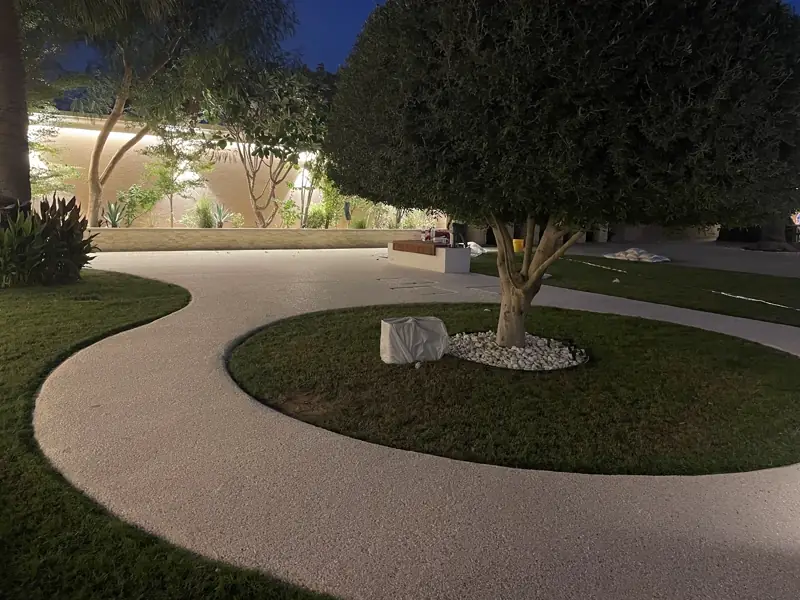
If you are into landscaping, you are likely familiar with resin bound — a decorative paving solution created by fully mixing natural coloured aggregates with transparent resin. Epoxy is probably the first word that comes to mind when you think of resin bound. You might also know that epoxy will yellow over time and polyurethane is a pricier but better alternative.
As a specialist supplier of various landscaping solutions with years of first-hand project experience, we supply premium-quality epoxy, polyurethane, acrylic, and other landscaping solutions. We always recommend the right choice for our clients based on their actual needs. Below are some scenarios where polyurethane has a clear advantage over epoxy.
1. Preserving the Light Original Colour of the Stone
When your project needs to show the original light colour of the stone — white, off-white, pale grey, and similar tones — and you are using transparent resin, you need the strong yellowing-resistance of polyurethane. Our TerraTight™ PU transparent system remains chemically stable against UV exposure for years. Epoxy, even specially engineered variants, only resists colour change for months. The change is painfully obvious on natural light-coloured stones, and no client will reasonably accept their landscape turning yellow and brown before it even gets worn.
UV exposure does not need to be direct to threaten your epoxy resin. Sunlight can reflect off walls or pass through windows, and some artificial light sources can be strong enough to make some regions of the resin bound darker than others. We therefore recommend you do not take any chances — prefer polyurethane over epoxy whenever you are working with light stones and transparent resin.
Some suppliers recommend a topcoat layer (polyurea, etc.) to prevent yellowing. From a cost-benefit point of view, topcoats add to construction time, create project management headaches, and cause colour mismatch when parts break off over time. In many projects without load-bearing requirements, we simply do not recommend the use of a topcoat.
If epoxy is required for a specific reason, choose dark stones or a yellowish-beige tone such as Chrysanthemum. Among light colours, yellowish-beige is the best at hiding colour change over time. We supply a wide variety of premium-quality washed stones — contact us to learn more.
2. Controlling Zone-to-Zone Colour Difference
Also related to yellowing is zone-to-zone colour difference. When undertaking a multi-day project in hot, sunny summer, by the time you start a new zone, previous work might have already begun to yellow. Colour banding is extremely difficult to moderate if you are working with a resin product that ages quickly against UV exposure, and it remains visible for a long time if the weather shifts unpredictably during construction and curing.
Working with polyurethane under UAE weather conditions significantly diminishes this risk. Even though polyurethane cures rapidly in heat, there are proven techniques to manage the material — including cooling the resin and the rocks during construction.
A simple fix is to roll a thin, uniform layer of epoxy as soon as all resin bound construction is finished — the sooner the better. If budget allows, a specialised yellowing-resistant topcoat is also an option, but our time-saving approach keeps things simpler and more affordable.
3. Faster Construction in Challenging Weather Conditions
For projects on tight timelines or scheduled during unpredictable weather, fast curing is a decisive advantage. Polyurethane achieves basic curing in roughly 0.5 days versus 1 day for epoxy, and full curing in 1 day versus 2–3 days. The longer the resin takes to cure, the greater the risk that weather will ruin it.
For moisture, we typically recommend no rain or extreme humidity in the 1–2 days before, during, and after construction. In the Middle East, dust storms are the major environmental threat to resin bound — sand particles blown into the pre-hardened surface are nearly impossible to clean, ruin the aesthetics, and decrease bonding strength.
If you must construct resin bound against unpredictable weather conditions, we recommend fast-curing TerraTight™ PU even if yellowing resistance is not your main concern.
Heating epoxy to accelerate curing can damage the bonding mechanism of the chemical, leaving it cured but not properly bonded. We do offer relatively fast-curing epoxy variants — contact us for more information.
4. Better Flexibility and Abrasion Resistance
Polyurethane is a more flexible chemical than hard and brittle epoxy. In the Middle East, where temperature differences between day and night can be considerable, micro-movement and thermal expansion of the substrate are inevitable. The flexibility of polyurethane helps the surface layer absorb these stresses and reduces the risk of cracking in the wearing course. Epoxy is relatively hard and brittle, so it is more susceptible to cracking under temperature changes or minor substrate movement.
Conclusion
Epoxy and polyurethane each have their own strengths and weaknesses and should not be viewed as high and low-end substitutes. Polyurethane excels in yellowing resistance and flexibility. We have outlined the scenarios where we would recommend polyurethane over epoxy — but every project deserves a specialised solution, and that is what we work hard to provide.
Let us visit your site, understand your requirements, and recommend the right product at a fair price. Our resin bound services page covers the full range of TerraTight™ PU and TerraTight™ Epoxy systems we offer.
Get Expert Advice for Your Project
Not sure which resin system is right for your surface? Our team will assess your site and recommend the best product — no obligation.